© Henry — Sadecki-Denkmal, 1974 — Zeiss Ikon Ikonta 521/2, darkroom print
The shoebox session so to speak that surfaced the Berlin photograph wasn’t done with me, or maybe I spent too much time on it. Either way, among the prints I pulled out that day was this one — and it stopped me as long as the East Berlin photo did. But hold that thought for a moment.
In 1974 I stood in a field outside Dorsten with my father’s Zeiss Ikon Ikonta and photographed a stone. A place I knew well. We’d been coming here as kids for years — close to the river Lippe, where I grew up. In summer the grass grew taller than we were. We played cowboys and Indians among the ruins of something we didn’t fully understand. But we heard rumors.
The stone was the Sadecki-Denkmal — a memorial erected during the Nazi era for Leo Sadecki, commemorated on its plaque as having fallen “fürs Vaterland” in the World War I aftermath. A glorification stone, dressed up as grief. The kind of monument that says more about the people who built it than the person it claims to honor — is my honest opinion. Why? Have a look!

Sadecki-Memorial inauguration — wreaths, swastika ribbons, and the posture of ideology
The inauguration photograph taken by propaganda press tells you everything. Four people standing at attention. Wreaths draped with swastika symbols and ribbons. A plaque bolted to a boulder. The propaganda machinery working, assembled and displayed.
After the war, someone demolished it. Who exactly, no one seems to know — or no one wanted to say. By the time we were kids, the basement of Zechenstein was still mostly intact, but everything else was rubble. The plaque — gone. The boulder split and torn apart. What remained was a ruin in a field, thankfully stripped of its purpose, slowly being absorbed into the landscape and in summer, often surrounded by cows grazing peacefully in the Lippe meadows. Which is, by the way, another reason this photograph speaks to me.
I was looking for a composition for the photography working group at my high school. The project was around World War II. I thought: let me check this place.
Looking at it now, I can see what I got right. The low angle forces you through the rubble before you reach the stone — confrontation without dramatization. That was the idea. Three tonal planes separate cleanly. The stone is slightly soft, the sky pays the penalty for that overcast day, and the frame pulls left-heavy. Not my strongest work technically. But the kid didn’t try to make the monument monumental. He shot across at it, level with the destruction. That was enough to earn a place in the high school yearly fine art photography exhibition.
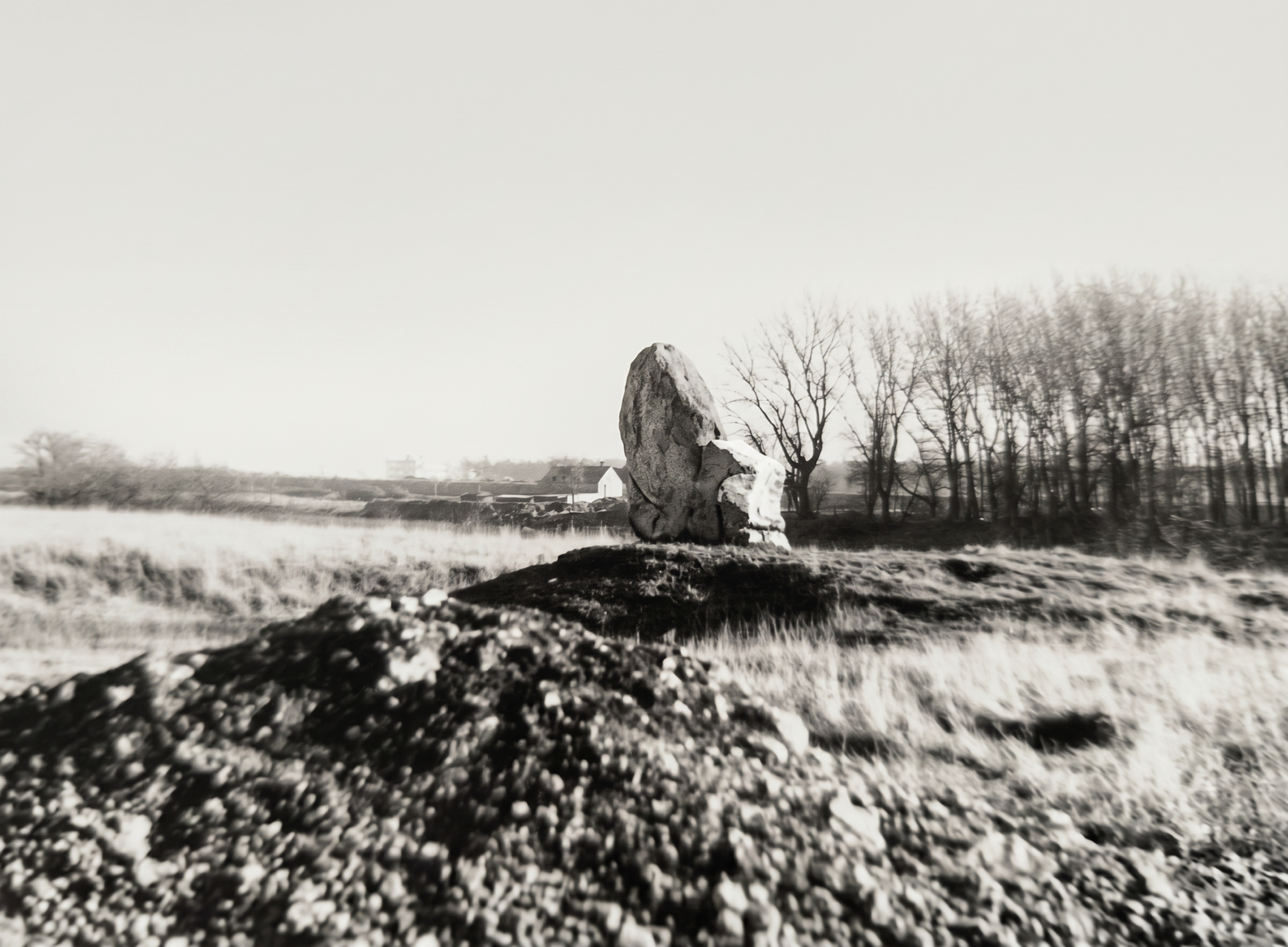
© Henry - Sadecki-Denkmal, 1974 — Zeiss Ikon Ikonta 521/2, darkroom print
It was a cold day. I shot from low, across the broken ground — from the opposite side of where the inauguration photo was taken by the propaganda press forty years earlier. In the background: the Hattkemper farm, the Lippe Busch, and what was left of the last bog. That same day, the city of Dorsten and a construction company had begun filling the bog with rubble from the coal mine, already piling up at the edge. Coal mining had already forced them to dam the Lippe in other areas and reduce its natural flow. The bog — our other childhood playground — was the next thing to go.
I didn’t know it then, but I was photographing between two erasures. The first had already happened — the monument smashed after the regime fell. The second was underway that same day — a landscape being buried under industrial waste. The remains of the Denkmal were removed about 5-10 years later. The bog is gone entirely, lost forever. But the farmhouse still stands.
I remember the day the water started disappearing. Members of our local fishing association — myself included — waded into the last standing water to rescue the fish. A small, futile act of care before a permanent loss.
Everything around this area has changed. The river is regulated. The bog is rubble. The monument is a memory, forgotten for the people who live there today.
This photograph is a darkroom print I made over fifty years ago. It’s not a scan from a negative — just a print that survived. The camera was my late father’s Ikonta, the same model I carry today. He didn’t take this picture. I did, with his camera, standing where he might have stood.
I don’t have a moral to attach to this. The stone is gone. The ideology proved harder to demolish. The photograph remains — not as art, but as evidence. Sometimes that’s what a camera is for, the art of witnessing.
— Henry
I publish my photography under my middle name Henry — a small tribute to my father Heinrich, and his lifelong love of making photographs.
If you find value in my content, consider supporting me with a virtual coffee ☕️ or a beer 🍺.
My Zines are available via Blurb, or in Books & Prints. Below a 15 pages preview of Doors of Perception Vol. 2.
-flickr.jpg)