A photographic essay on landscape, geological time, and the slow discipline of seeing in monochrome. Edition 2, 2026.
“…every thing would appear to man as it is, infinite.” — William Blake
Edition 1 of The Doors of Perception used the first half of Blake’s thought. The cleansing. The pause at the threshold. The decision to look.
Edition 2 uses the second half. The infinite.
When I penciled down the concept for Edition 1, I thought about — depending how the essay works for me — what would be the next evolution? The first one ended with a photograph of weathered binoculars (well, not really binoculars, but you get the point I think) pointing out to sea — I Still Haven’t Found What I’m Looking For. That felt like the right closing. The search continues. Perception never completes itself. Keep looking.
Then, in early May, I stood inside Zion for the first time. My goal was to take different photos than in the past — to cover the light and shades, and to restrict myself to black and white. My “monochrome eye” was impressed: canyon walls pressing in from both sides, the light shifting with every turn. Two rolls of Ilford XP2 Super. Reloading the Pentacon Six on a narrow rim, the backpack with the second lens, the heavy Pentacon in my hands and with the canyon falling away beneath me, hands steady, trying not to think about what if I drop the camera, or the film. That kind of concentration changes how you see. It has to.
By fall I was at the rim of the Grand Canyon with thirteen frames of Ilford FP4 Plus 125 in the Pentacon Six, and honestly, the whole approach shifted. There were no doorways here. No windows, no frames, no architectural thresholds. Just two billion years of silence, indifferent to the camera, indifferent to whether I saw it or not. The constructed spaces of Edition 1 — those careful thresholds between inside and outside — meant nothing here. The land did not need framing. It needed witnessing.
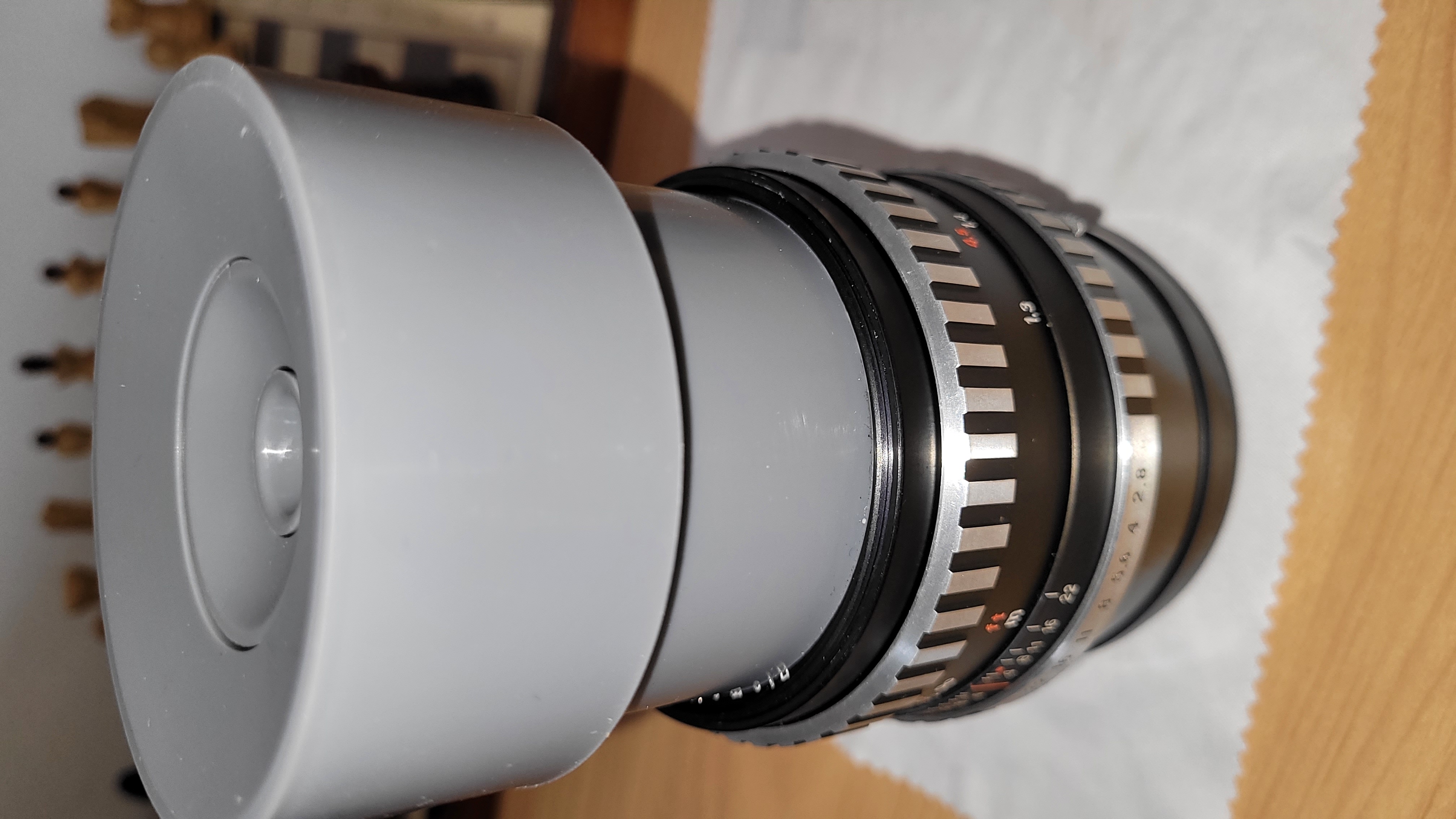
The monsoon was late that fall. At the Grand Canyon you could already feel it building — cloud drama stacking up in late afternoon, the sky performing for the red filter. By the time we reached Sedona, it hit. And with the monsoon came excessive heat — the kind that doesn’t just change the light but changes the equipment. My Carl Zeiss Jena Biometar 120mm f/2.8 crossed its own threshold somewhere in that heat. Due to the filter I used and the strategy to slightly underexpose, luckily none of the negatives came back heavily overexposed. The aperture had stuck wide open at f/2.8. I didn’t know it during the hike — the ring still moved, but the blades had seized. Desert temperatures had driven old grease into the iris. The full repair story came later, back home, with isopropanol and patience and a few moments of genuine panic. The lens now works better than when I bought it. But that’s the thing about working in places older than you — the land doesn’t care about your equipment any more than it cares about your plans.
That is how this book began. Not with a concept, but with the concept failing. And not with everything working, but with the desert reminding me who was in charge.
Seeing in Monochrome
The Grand Canyon, Sedona, Zion — these are among the most photographed landscapes on earth. In color, they are spectacle. The reds, the oranges, the sunset light on sandstone. Millions of photographs exist of these places, and nearly all of them say the same thing: look how beautiful.
I was not interested in that. No longer I have to say.
These photographs approach landscape through structure rather than spectacle — layers, horizons, rims, and tonal separation describing depth, distance, and scale without reliance on color. Working in black and white reduces the landscape to light and form. The images are less about specific places than about space itself: how land organizes, how light moves across it, and how stillness emerges when color is removed.
To load black-and-white film is to make a decision before the shutter opens. You choose — before the exposure, before the light even enters the lens — to see the world this way. Sedona’s red rock becomes gray. The Grand Canyon loses its postcard drama. What remains is form, weight, texture, and the way a shadow organizes a wall. This is not a stylistic choice. It is a perceptual commitment. You are not removing color afterwards. You are choosing not to see it in the first place.
The influence here is Ansel Adams. That needs to be said honestly. The tonal discipline, the attention to how rock separates from sky in monochrome, the idea that the print itself is a performance of light — that is Adams territory, and I am working in it.
But the relationship is dialogue, not imitation. Adams worked with an 8×10 view camera on a tripod. He pre-visualized every tonal value through the Zone System before he released the shutter. Total control. Mastery over the landscape. His photographs say: I stood here and commanded this scene.
My approach is different. I shoot handheld on a Pentacon Six TL. 6×6 square format, Carl Zeiss Jena Biometar lenses — the 80mm and the 120mm — with yellow or red filtration to separate sky from stone. Sometimes a CPL. Ilford FP4 Plus 125 and Ilford XP2 Super 400. Twelve frames to a roll — thirteen if you know the loading hack, and it works every time.
Where Adams composed, I responded. Where he mastered, I received. His photographs say I stood here and commanded this scene. Mine say something closer to I stood here and the landscape spoke first. The titles I gave these photographs tell that story. But more on that in a moment.
Four Movements
Like Edition 1, this photographic essay is structured not as a portfolio but as a sequence — a conversation that builds toward something. The photographs are ordered by perception, not geography or chronology. The movements describe stages of seeing, not stops on a trip or a hike. That distinction matters to me. This is not a travel book. It’s not about showing nice pictures. It’s about relearning to see — the philosophy, the art of seeing.
I — CONFINEMENT
The walls were always there. Seeing them is the first opening.
Seven photographs from Zion. This was the beginning — early May, my first serious encounter with landscape at this scale. And I’ll be honest: the confinement in these images is not just the canyon’s. It is the photographer’s — me, trying to find a visual language for something that exceeds every frame you try to put around it.
Zion presses in. The walls are not background; they are the subject. They fill the frame, crowd the sky, refuse to yield. What happens to perception when space narrows? When there is no panorama, no escape, no horizon to rest the eye on? Just stone, close, vertical, and old beyond comprehension.
The titles carry that weight: Stone That Refuses to Move. Erosion Has a Language. Paths That Never Were. These are not descriptions of what the rock looks like. They are descriptions of what the rock does — how it resists, how it speaks, how it offers routes it never intended. Close in on the sandstone and it starts to speak: layered, wind-carved, compressed into horizontal sentences. Time made legible. The earth’s memory written in stone, if you know how to read it.
And here is the thing — this is how most of us move through the world, isn’t it? Enclosed by habit. Following paths that aren’t. Walking past everything. Seeing nothing. The walls were always there. Seeing them is the first opening.

Erosion Has a Language — CONFINEMENT movement. Pentacon Six TL, Carl Zeiss Jena Biometar f2.8/80mm, Ilford XP2 Super
II — CHARACTER
Where stone finds gesture, perception finds its voice.
Six photographs from Sedona. After Zion’s enclosure, everything changes — not just the geology but the quality of the air, the silence, the weight of the place. It’s hard to explain without sounding like a brochure, but I’ll try.
Sedona and Oak Creek Canyon sit on what people call spiritual land. I’m a photographer, not a mystic, but I’ll say this: sitting at Buddha Beach, looking across at Cathedral Rock with the vortex energy settling around you, the word spectacle stops meaning anything. You are not looking at a view. You are sitting inside something. The rock is not performing for you. It simply is. And you either see that or you don’t.
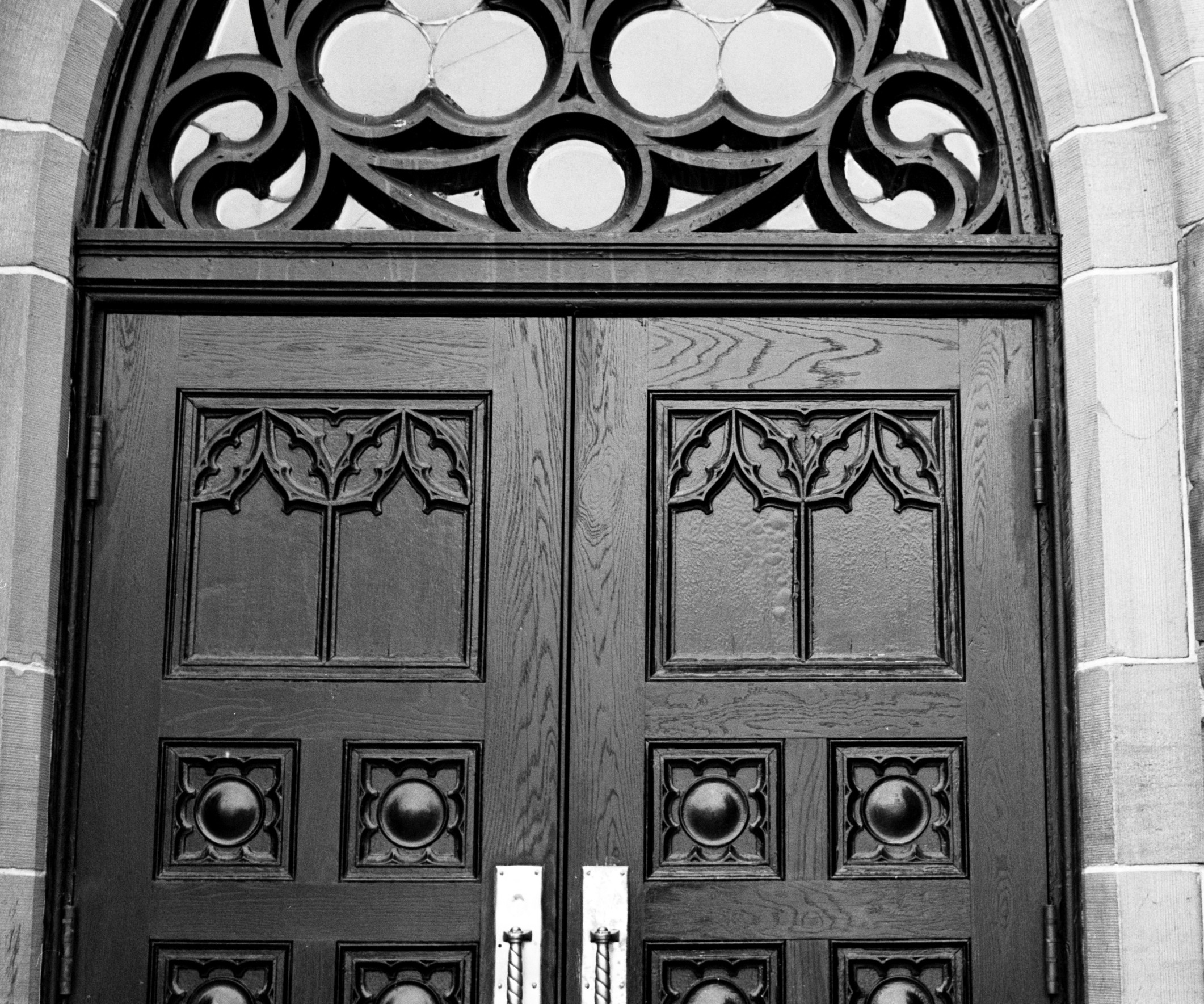
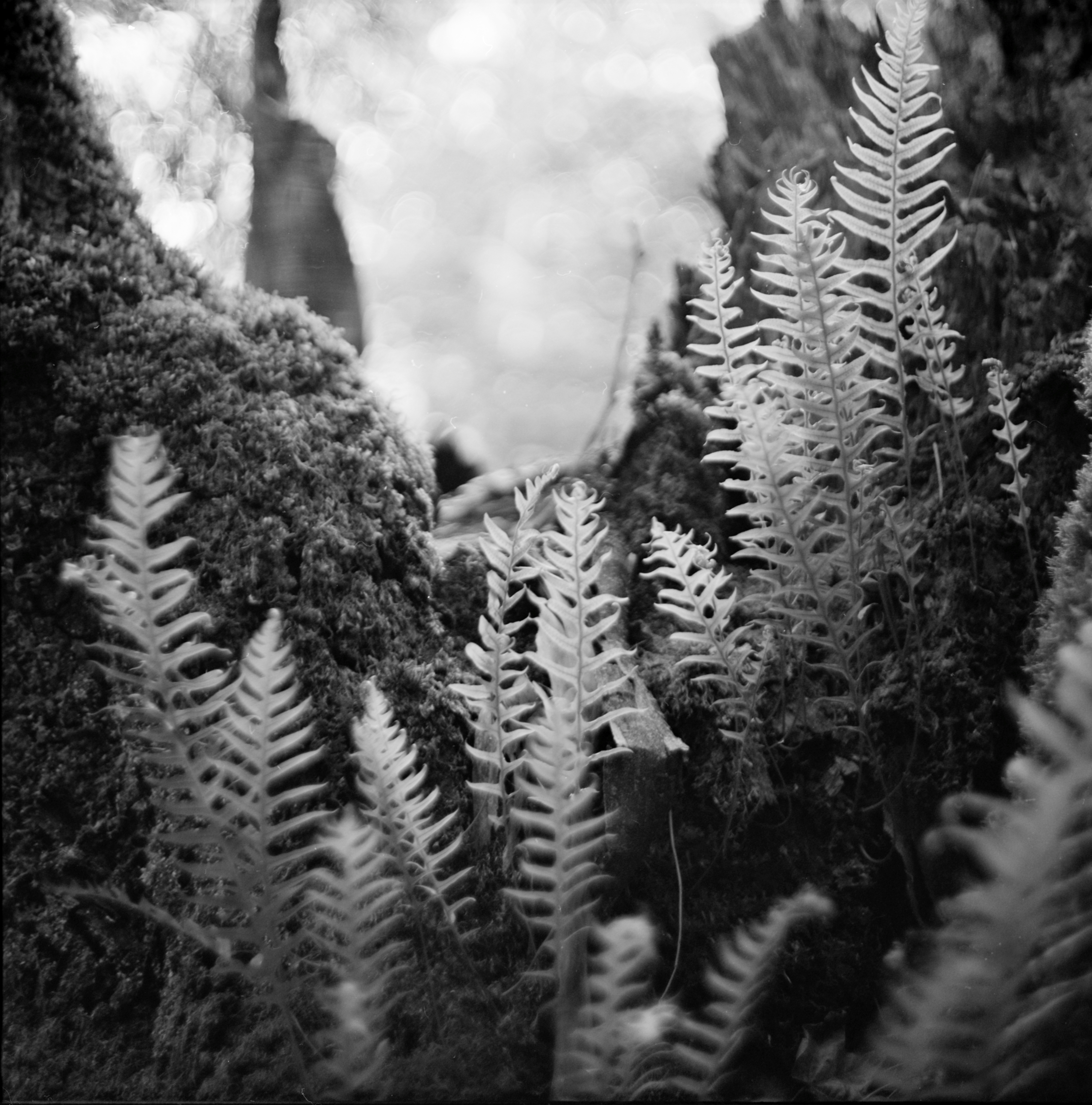
The cover image and the book’s opening photograph were both made in Oak Creek Canyon — the ruins of the Mayhew Lodge, built in the 1870s, operated as a guest lodge for nearly a century, then burned by the Forest Service in 1980. What remains is stone and collapse. Doors and windows that have stopped functioning. You can see through the walls, through the roof, through everything. A place people once entered, slept in, left from — now open to the sky. The threshold has dissolved. That is where Edition 2 begins: at the last threshold, before the land takes over.
Where Zion confines, Sedona reveals. The formations here are not walls — they are presences. Rock that holds itself against gravity like an act of will. Cathedral Rock standing with the authority of something that knows it will outlast everything looking at it. Courthouse Butte sitting in the middle distance with the self-possession of something that has never needed to prove anything. The titles follow: The Arch That Holds Itself. The Cathedral Stands Alone. The Quiet Authority. The stone finds gesture, and perception finds its voice.
One image in this movement stands apart, and it has a story worth telling. What the Heat Takes Back — Cathedral Rock seen from a plateau you can only reach via a trail that javelinas wore into the rock and shrubs over generations. Not a maintained path, not on any map — an animal trail leading to a flat expanse of stone with a direct view across the valley. I arrived after the monsoon. Water on the rock surface — puddles already evaporating in the heat. I had minutes, not the luxury of slow composition. The landscape dictated the tempo. The Pentacon Six handheld, trying to capture the puddle in the foreground with Cathedral Rock behind before the heat erased it. This is the one image in the book where the land forced me to work on its terms, not mine. The water was gone within minutes. The photograph is what remains.

What the Heat Takes Back — CHARACTER movement. Cathedral Rock from the javelina trail plateau. Pentacon Six TL, Carl Zeiss Jena Biometar, Ilford XP2 Super
III — EXPANSION
The land opens what attention began.
Eight photographs across two rolls from the Grand Canyon. After Zion’s confinement and Sedona’s character, the land opens. The sky takes over. The scale exceeds the frame. And something shifts in the photographer too — you stop trying to contain the landscape and start letting it contain you.
The monsoon was already announcing itself here — cloud drama building through late afternoon, the sky darkening and lifting in ways that the red filter on the Biometar turned into tonal theater. You could feel the weather coming before you could see it. The land and the sky were in conversation, and I was eavesdropping.
This movement is about what happens to perception when confinement breaks and the horizon appears. The canyon does not reveal itself in one view. It layers — epoch over epoch, silence over silence, each stratum a different tone of gray, each one a record of something the planet once was. The titles try to honor that: Every Layer a Different Silence. Where the Earth Opens Its Archive. Depth Without Anchor — that vertiginous moment when there is no foreground, no frame, nothing to hold, just depth falling away from the eye. Not awe, exactly. More like a loss of spatial certainty. That is closer to what it actually feels like to stand at the rim than any postcard will tell you.
Clouds over Deep Time closes the movement — and nearly closes the book. The sky and the canyon in full dialogue. Clouds that will be gone in an hour, drifting over rock that has been here for eons. It is the widest image in the book. The doors of perception, once cracked in a Zion canyon, now stand wide against the infinite.

Clouds over Deep Time — EXPANSION movement. Grand Canyon. Pentacon Six TL, Carl Zeiss Jena Biometar, red filter, Ilford FP4 Plus
IV — SEEING
Edition 1 closed with I Still Haven’t Found What I’m Looking For — binoculars pointing out to sea, the search unresolved.
Edition 2 closes with A Sort of Homecoming.
Stairs leading up to a closed door. The Old Juel Farmhouse, abandoned, a mile from my home in Redmond. I have walked and biked past it more times than I can count without registering this door existed. Then I spent a week in places older than language — Zion’s walls pressing in, Sedona’s rock finding gesture, the Grand Canyon opening its archive — and when I came home, I saw it.
The stair. The door. The porch. Throughout the years, the Juels raised vegetables, blueberries and flowers amongst the 100-year-old trees. Bear Creek in the backyard.
The same door I’d been photographing in different forms across two editions of this zine — thresholds, frames, passages, ruins. It had been there the whole time, waiting for me to see it.
Those who know the reference will recognize both titles. Same album — The Unforgettable Fire, 1984. Edition 1 ended with the restlessness of not having found. Edition 2 ends with a sort of return. Not resolution. Not completion. But a recognition that the journey changed how I see home.
The closing image was shot on the Pentacon Six TL with the MIR 38B 65mm f/3.5 — a Ukrainian-made wide angle I was testing on a new roll of Ilford XP2 Super. A test roll. An accidental threshold. The image happened not because I was prepared, but because I was looking.
If you have a photographic eye, you never stop making photographs. Even without a camera. Even in your mind.
A Sort of Homecoming

The last door was always there. SEEING — Pentacon Six TL, MIR 38B 65mm f/3.5, Ilford XP2 Super
The Camera Gear
All photographs in the desert movements were made on a Pentacon Six TL with Carl Zeiss Jena Biometar lenses — 80mm f/2.8 and 120mm f/2.8. Filtration: yellow, red, or CPL depending on conditions. Zion was shot entirely on Ilford XP2 Super 400, two rolls in early May. The Grand Canyon followed in fall on two rolls of Ilford FP4 Plus 125, with one roll of FP4 Plus in Oak Creek Canyon before switching to XP2 Super for Sedona. The closing image: Pentacon Six TL, MIR 38B 65mm f/3.5, Ilford XP2 Super.
The Biometar 120 did not survive the desert unscathed — the heat drove old grease into the iris and seized the aperture at f/2.8. The full repair story is here. It came back stronger. So did I.
No digital capture. No post-conversion to monochrome. Every frame was seen in black and white at the point of exposure. That is not a workflow detail. It is the philosophy of the work.
What the Land Remembers
Blake’s line was not about hallucination or altered states. It was about clearing away the habit of non-seeing. The idea that the world is already infinite — if you choose to look at it that way.
You don’t come back the same from places older than language. Not because they are grand — though they are. But because they are indifferent to your presence, and that indifference is a kind of gift.
The land remembers what we walk past. These photographs are what I refused to forget.
© 2026 Henry
I publish my photography under my middle name Henry — a small tribute to my father Heinrich, and his lifelong love of making photographs.
If you find value in my content, consider supporting me with a virtual coffee ☕️ or a beer 🍺.
The zine is available via Blurb, or in Books & Prints. Below a preview.